



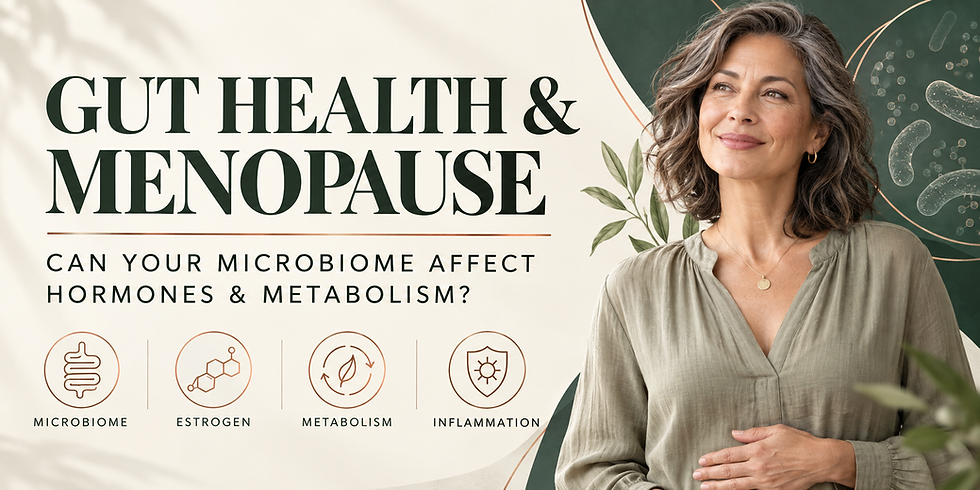
Gut Health and Menopause: Can Your Microbiome Affect Hormones and Metabolism?

When women think about menopause, they usually think about the ovaries.
But researchers are increasingly studying another system that may interact with hormonal health:
The gut microbiome.
The trillions of microorganisms living in your digestive tract participate in digestion, immune function, production of microbial metabolites, and aspects of metabolism.
They may also interact with estrogen metabolism.
This has created enormous interest in the relationship between gut health and menopause—including whether changes in the microbiome could influence metabolic health, inflammation, body composition, and menopausal symptoms.
But this is also an area where social media often moves faster than the science.
The gut microbiome appears important, but we don't yet have a specific “menopause microbiome” that doctors can diagnose or a probiotic that reliably “balances your hormones.”
Here's what we actually know.
What Is the Gut Microbiome?
Your digestive tract contains a complex community of:
Bacteria
Viruses
Fungi
Other microorganisms
Together, these microorganisms and their genetic material make up what we commonly call the gut microbiome.
The microbiome can be influenced by many factors, including:
Diet
Age
Medications
Antibiotic exposure
Physical activity
Geography
Environment
Health conditions
Hormonal status may be another factor.
Research has found associations between menopause and differences in gut microbial composition, although results vary considerably between populations and studies. (PubMed)
What Happens to the Gut Microbiome During Menopause?
This is where the science becomes interesting—and complicated.
Some individual studies have reported differences in microbial diversity and specific bacterial populations between premenopausal and postmenopausal women. Reviews have therefore proposed that declining estrogen may influence the gut microbial environment. (PubMed Central (PMC))
However, we should be careful not to overstate this.
A recent systematic review and meta-analysis found no consistent significant differences in overall alpha diversity or the major bacterial phyla Firmicutes and Bacteroidetes between women with lower estrogen states and premenopausal controls. The included studies were also highly heterogeneous. (PubMed Central (PMC))
So the current evidence does not support a simple idea that:
Menopause = one predictable unhealthy microbiome.
The relationship appears much more individualized.
Meet the “Estrobolome”
One of the most interesting concepts in menopause research is the:
Estrobolome
The estrobolome refers to gut microbial genes and enzymes involved in estrogen metabolism.
Here's the simplified version.
After estrogen has been metabolized by the liver, some estrogen metabolites enter the intestine through bile.
Certain gut bacteria produce enzymes, including β-glucuronidase, that can deconjugate estrogen metabolites.
Some of that estrogen can then potentially be reabsorbed into circulation through enterohepatic recycling. (PubMed Central (PMC))
In other words:
Your gut doesn't manufacture ovarian estrogen, but gut microbes may participate in how estrogen is metabolized and recycled.
That's an important distinction.
Is the Relationship Two-Way?
Probably.
Researchers increasingly describe a bidirectional relationship:
Estrogen may influence the gut microbiome.
And:
The gut microbiome may influence estrogen metabolism.
Declining ovarian estrogen could alter the intestinal environment, while microbial enzymes may affect the metabolism and recirculation of estrogens. (PubMed)
This estrogen–microbiome interaction is scientifically plausible and increasingly studied.
But many questions remain unanswered.
Can Your Microbiome Affect Menopause Belly Fat?
Possibly—but this is where we need to separate association from causation.
The microbiome participates in processes related to:
Energy metabolism
Glucose regulation
Bile-acid metabolism
Inflammation
Production of short-chain fatty acids
At the same time, menopause is associated with changes in body composition and cardiometabolic risk.
Researchers are therefore investigating whether microbiome changes contribute to these metabolic shifts. (PubMed)
Animal research provides interesting mechanistic evidence. For example, experimental changes in ovarian hormone status can alter the microbiome and metabolic outcomes in mice. (PubMed)
But human evidence remains much less definitive.
We cannot currently say:
“Your gut bacteria are the reason you're gaining belly fat during menopause.”
Body composition during midlife is influenced by many factors, including:
Aging
Estrogen changes
Muscle mass
Nutrition
Physical activity
Sleep
Insulin sensitivity
Genetics
Medications
Overall energy balance
The microbiome may become another piece of that puzzle—but it isn't the whole explanation.
What About Inflammation?
Gut microbes produce numerous metabolites that communicate with the immune system and other organs.
One important group is short-chain fatty acids (SCFAs), which are produced when certain bacteria ferment dietary fibre.
SCFAs have roles in:
Gut barrier function
Immune regulation
Energy metabolism
Metabolic signaling
Researchers are investigating whether menopause-associated microbial changes could affect these pathways and contribute to metabolic or inflammatory changes. (PubMed Central (PMC))
Again, this is an evolving area of research rather than a clinical test we can currently use to diagnose someone's menopause symptoms.
Can Gut Health Affect Blood Sugar?
Potentially.
The gut microbiome has been extensively studied in relation to obesity, insulin resistance, and type 2 diabetes.
Menopause also occurs during a period when many women experience changes in:
Visceral fat
Muscle mass
Insulin sensitivity
Lipid profiles
This overlap has led researchers to investigate whether the microbiome helps mediate some of these metabolic changes.
Recent reviews suggest plausible links between menopause-related microbial changes and lipid metabolism, inflammation, and cardiometabolic health—but they also emphasize that human findings remain heterogeneous and causation is difficult to establish. (PubMed)
So improving metabolic health shouldn't depend on trying to manipulate one bacterial species.
Can Gut Health Affect Bone Health?
Another emerging area involves the gut–bone axis.
Bone health after menopause is strongly influenced by estrogen loss.
Researchers are also investigating whether microbial metabolites, inflammation, nutrient absorption, and immune signalling could influence bone remodelling.
Several observational and experimental studies have found associations between gut microbial patterns and postmenopausal bone health. (PubMed Central (PMC))
But we don't currently treat osteoporosis by simply “fixing the microbiome.”
Established factors remain critical:
Resistance and weight-bearing exercise
Adequate protein
Calcium
Vitamin D
Avoiding smoking
Appropriate screening
Medication when medically indicated
Can the Microbiome Cause Menopause Symptoms?
We don't have enough evidence to say that.
Studies have reported associations between certain microbial patterns and menopausal symptoms, but association does not establish that those microbes caused the symptoms. (PubMed Central (PMC))
That's an important distinction because claims such as:
“Your hot flashes are caused by gut dysbiosis.”
or
“Heal your gut, and you'll balance your estrogen.”
go beyond what current human evidence can support.
The microbiome may influence menopause physiology, but we're still learning exactly how clinically important those effects are.
Should You Take Probiotics During Menopause?
Maybe—but don't expect a universal menopause probiotic.
Probiotics are live microorganisms that may provide specific health benefits when consumed in adequate amounts.
Research into probiotics and menopause is growing. Some studies suggest that certain strains or combinations may influence metabolic markers or other health outcomes.
However, effects are often strain-specific, and current evidence isn't strong enough to recommend one probiotic formulation to every menopausal woman.
Recent reviews describe probiotics and prebiotics as promising but emphasize that better clinical evidence is still needed. (PubMed)
So:
“Take any probiotic for hormone balance”
is not an evidence-based recommendation.
What About Prebiotics?
Prebiotics are substrates—often certain types of fermentable fibre—that beneficial microorganisms can use.
Instead of simply adding bacteria through a supplement, one strategy is to feed the microbial community already living in your gut.
Prebiotic-rich foods may include:
Onions
Garlic
Leeks
Asparagus
Legumes
Oats
Certain whole grains
Some fruits and vegetables
But you don't need to memorize a list of “microbiome superfoods.”
A diverse, fibre-rich dietary pattern is a more practical place to start.
Fibre May Matter More Than the Latest Probiotic
Before spending hundreds of dollars on microbiome supplements, look at your everyday diet.
Gut microbes ferment certain fibres and produce beneficial metabolites, including short-chain fatty acids.
A diet rich in a variety of plant foods can provide both fibre and diverse substrates for the gut microbiome.
Consider regularly including:
Vegetables
Fruits
Beans
Lentils
Chickpeas
Whole grains
Nuts
Seeds
Increase fibre gradually if your current intake is low, particularly if you experience bloating or gastrointestinal symptoms.
What About Fermented Foods?
Fermented foods can be another component of a varied diet.
Examples include:
Yogurt with live cultures
Kefir
Sauerkraut
Kimchi
Some fermented vegetables
But fermented foods aren't a menopause treatment.
Think of them as one possible part of an overall dietary pattern rather than a way to “reset” your microbiome.
Does Eating Soy Affect the Microbiome and Estrogen?
Soy is particularly interesting because it contains isoflavones, a type of phytoestrogen.
Gut bacteria participate in metabolizing these compounds, and individuals differ in their ability to produce certain metabolites such as equol.
This is one example of why two women can consume the same food yet have somewhat different biological responses.
Researchers are studying how diet, phytoestrogens, and microbiome composition interact during menopause, but personalized microbiome-based nutrition is still an emerging field. (PubMed)
Do You Need a Commercial Microbiome Test?
For most women experiencing routine menopause symptoms, commercial stool microbiome testing isn't currently a standard diagnostic requirement.
These tests may provide interesting information about bacterial DNA in a stool sample, but translating that information into reliable clinical decisions is much more difficult.
There is currently no universally accepted definition of the “ideal menopausal microbiome.” Recent research continues to show substantial variation between populations. (PubMed)
A colourful report showing that one bacterial species is “low” doesn't automatically mean it is causing your symptoms—or that taking a supplement to increase it will improve them.
What About “Gut Detoxes”?
Your digestive tract doesn't need a social-media detox to process estrogen.
And juice cleanses, extreme restriction, colon cleanses, or large supplement protocols aren't required to “remove bad estrogen.”
Your body already has sophisticated systems involving the:
Liver → bile → intestine → kidneys
that metabolize and eliminate substances.
The microbiome participates in some of these processes, but supporting health is different from trying to “flush toxins” from the body.
When Digestive Symptoms Need Medical Attention
Not every digestive symptom during menopause is hormonal or microbiome-related.
Talk with your healthcare provider if you develop:
Persistent abdominal pain
Blood in the stool
Unexplained weight loss
Persistent diarrhea
Significant constipation
New or progressive changes in bowel habits
Persistent vomiting
Difficulty swallowing
Iron-deficiency anemia
New symptoms deserve appropriate evaluation rather than automatically being attributed to menopause or “dysbiosis.”
How Can You Support Gut and Metabolic Health During Menopause?
You don't need an expensive microbiome protocol.
Start with the fundamentals.
Eat a Variety of Plant Foods
Different plant foods provide different fibres and bioactive compounds.
Rather than chasing one “perfect” food, focus on dietary diversity.
Get Enough Fibre
Vegetables, fruits, legumes, whole grains, nuts, and seeds are valuable sources.
Eat Adequate Protein
Protein becomes increasingly important for protecting muscle during midlife.
Exercise Regularly
Both resistance training and aerobic activity support metabolic health, and physical activity has also been associated with differences in microbial diversity. (PubMed Central (PMC))
Protect Your Sleep
Poor sleep can influence appetite, insulin sensitivity, stress, and food choices.
Use Antibiotics Appropriately
Antibiotics can substantially alter gut microbial communities. Use them when medically indicated rather than avoiding necessary treatment or taking them unnecessarily.
Why We Don't Treat the Gut in Isolation
At ConductMD, we don't simply ask:
“Do you have dysbiosis?”
We ask:
“What is happening across the systems that influence your health?”
A woman experiencing bloating and weight gain during menopause may simultaneously have:
Changing ovarian hormones
Reduced muscle mass
Poor sleep
Insulin resistance
Dietary changes
Stress
A gastrointestinal condition
Trying to solve everything with a probiotic may overlook the actual drivers.
The CONDUCT™ Method
Through the CONDUCT™ Method, we evaluate seven interconnected systems:
C — Cortisol & Nervous System: Stress, sleep, and nervous-system regulation.
O — Ovarian Hormones: Estrogen, progesterone, testosterone, perimenopause, and menopause.
N — Nutrition & Glucose: Dietary quality, protein, fibre, glucose regulation, and metabolic health.
D — Digestion & Detoxification: Digestive function, bowel health, nutrient absorption, and the body's natural elimination pathways.
U — Urinary & Pelvic Health: Bladder, vaginal, pelvic, and sexual health.
C — Body Composition: Muscle, visceral fat, strength, and metabolic health.
T — Thyroid & Total Energy: Thyroid function and other contributors to energy.
The microbiome may be one part of this interconnected picture.
Seven Systems. One Harmony. You.™
Frequently Asked Questions
Does menopause change your gut microbiome?
Possibly. Individual studies have identified differences between pre- and postmenopausal women, but results vary. A recent meta-analysis did not find consistent differences in overall microbial diversity or major bacterial phyla, so more high-quality research is needed. (PubMed Central (PMC))
Can gut bacteria affect estrogen?
Gut bacteria contain enzymes involved in estrogen metabolism and enterohepatic recycling. This collection of microbial functions is commonly called the estrobolome. (PubMed)
Can poor gut health cause menopause belly fat?
There is not enough human evidence to say the microbiome directly causes menopause-related abdominal fat. Researchers are investigating links between gut microbes and metabolic health, but body composition is influenced by many factors. (PubMed)
Should women take probiotics during menopause?
Not automatically. Some probiotic interventions are promising, but benefits depend on the strain and outcome being studied, and evidence remains limited. (PubMed)
Can probiotics increase estrogen?
Some microbial pathways participate in estrogen metabolism, but taking a general probiotic cannot currently be assumed to meaningfully or predictably increase estrogen levels in women.
Do I need microbiome testing during menopause?
Usually not as part of standard menopause evaluation. Research has not established one ideal microbiome profile for menopausal women or validated routine microbiome testing for directing menopause treatment. (PubMed)
The Bottom Line
Your gut and your hormones do communicate.
The gut microbiome participates in estrogen metabolism, while hormonal changes during menopause may influence the intestinal microbial environment.
Researchers are also exploring connections with:
metabolism • inflammation • body composition • bone health • glucose regulation
But the science is still developing.
We don't yet have evidence that one microbiome profile causes menopause symptoms—or that a specific probiotic can “balance your hormones.”
For now, the strongest strategy is much less glamorous:
Eat a diverse, fibre-rich diet. Get adequate protein. Exercise. Protect your sleep. Support metabolic health. And investigate persistent digestive symptoms appropriately.
At ConductMD, we look at gut health as one interconnected part of your overall health—not an isolated system.
🇨🇦 If you’re in Canada, book your personalized consultation today.
Related Articles
References & External Links
Comments